Planning Steel Internal Doors for a 2026 Renovation: What to Consider Early
January is when ideas become intent. Floor plans are revisited, Pinterest boards become briefs and conversations shift from “one day” to “this year.” For many homeowners, architects and designers, steel internal doors are firmly on the wish list, yet they are still too often treated as a finishing detail.
In reality, steel internal doors are architectural elements, not accessories. They interact directly with structure, fire strategy, light flow, proportions and the overall language of an interior. When they are planned early, they elevate a renovation. When they are introduced late, they are frequently compromised and restricted by already made design choices.
As we move into 2026, we are seeing a growing number of clients approach steel doors differently; engaging earlier, asking better questionsand achieving far stronger results as a consequence. This guide explains exactly what to consider, when to consider it and why timing matters more than most people realise.
Why Steel Internal Doors Should Be Considered Early
Steel internal doors sit at the intersection of multiple design and technical decisions. They are affected by — and influence — far more than just an opening in a wall.
When considered early, steel doors can be used to:
Define spatial rhythm and hierarchy
Maximise light through deeper floor plans
Create height and vertical emphasis
Integrate fire safety without visual compromise
Align with wider architectural detailing
When considered late, we often see:
Reduced door heights due to fixed bulkheads
Limited configurations due to spatial constraints
Rushed design choices
Fire-rated doors that don’t match the rest of the scheme
Early planning allows steel doors to feel designed into the home, rather than added to it.
Structural Openings, Bulkheads & Ceiling Heights
One of the most impactful — and frequently missed — opportunities in a renovation is door height.
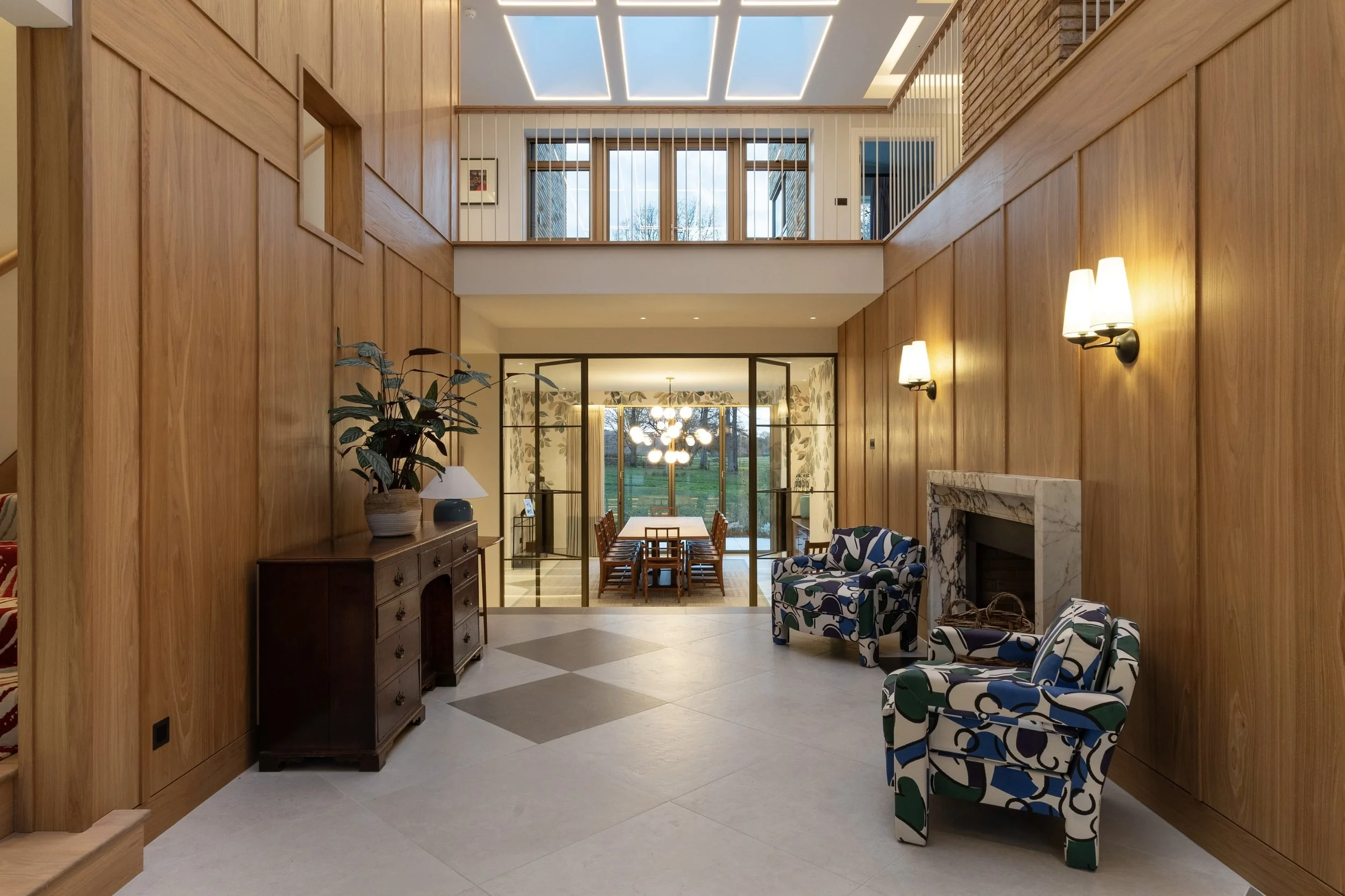
In many properties, particularly period homes and extensions, openings are capped with bulkheads that exist more from habit than necessity. When steel doors are discussed early, bulkheads can often be removed or redesigned to create:
Taller openings
Full-height doors
Stronger vertical sightlines
A more architectural sense of scale
Even an additional 200–300mm of height can dramatically change how a space feels, making rooms feel more connected and open.
Steel doors benefit particularly from height because their slim frames allow the eye to travel uninterrupted from floor to ceiling, reinforcing proportion and openness.
When planned properly, steel single doors can be paired with fixed screens
Choosing the Right Configuration (Before Layouts Are Fixed)
Steel doors are not a single product type. Configuration choices made early have a direct impact on structure, usability and aesthetics.
Key decisions to make early include:
Single vs double doors
Hinged vs sliding
Fixed side screens or overpanels
Fire-rated vs non-fire-rated
Bar layout and overall design
Leaving these decisions until late often forces compromise, particularly where openings are already built.
Early planning allows openings to be sized correctly, proportions to be balanced and door movement to be optimised.
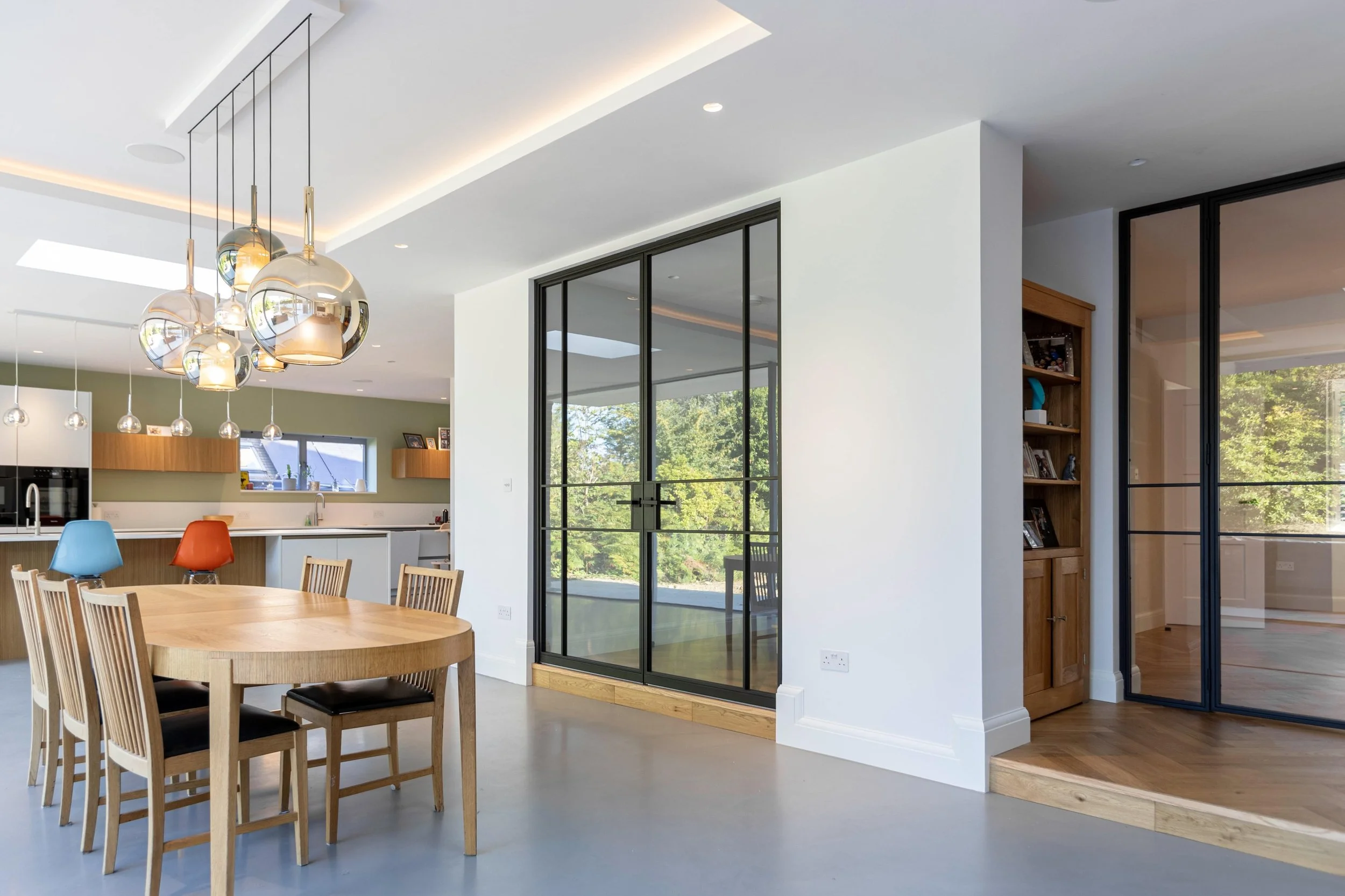
Double Steel Doors are a popular choice, where space allows.
Fire Safety & Building Control: Don’t Leave This Late
One of the most common challenges we see in renovations is fire-rated doors being introduced too late in the process.
Building Control is increasingly involved in residential projects, especially where:
Open-plan layouts are used
Kitchens open directly onto escape routes
Staircases connect to habitable spaces
Basements or loft conversions are involved
When fire-rated doors are considered early, they can be:
Designed to match non-fire-rated doors
Integrated seamlessly into the layout
Proportioned correctly within taller openings
Treated as part of the architecture, not an afterthought
Fire safety does not have to mean heavier frames or compromised sightlines, but it does require early coordination.
Design and configuration play a massive part in the visual success of fire-rated steel doors & screens.
Steel Doors & Building Control: What Clients Often Don’t Realise
Beyond fire ratings, Building Control considerations can influence:
Opening widths
Door swing direction
Handle types
Threshold detailing
Visibility between spaces
When steel doors are introduced late, adjustments are often required, sometimes forcing design changes that could have been avoided.
Early engagement allows:
Fire strategy to be considered holistically
Door specifications to align with regulations
Fewer redesigns at later stages
Smoother approvals
Desired result achieved
This is particularly important in larger renovations and projects involving multiple floors.
Glazing Choices: More Than Just Clear or Obscure
Glass is not simply a functional infill — it is a design tool.
Early planning allows clients to consider:
Full flexibility with door configurations
Use of both fixed and moving elements
Doors that become an integral part of the space, rather than doors that get in the way
Privacy requirements
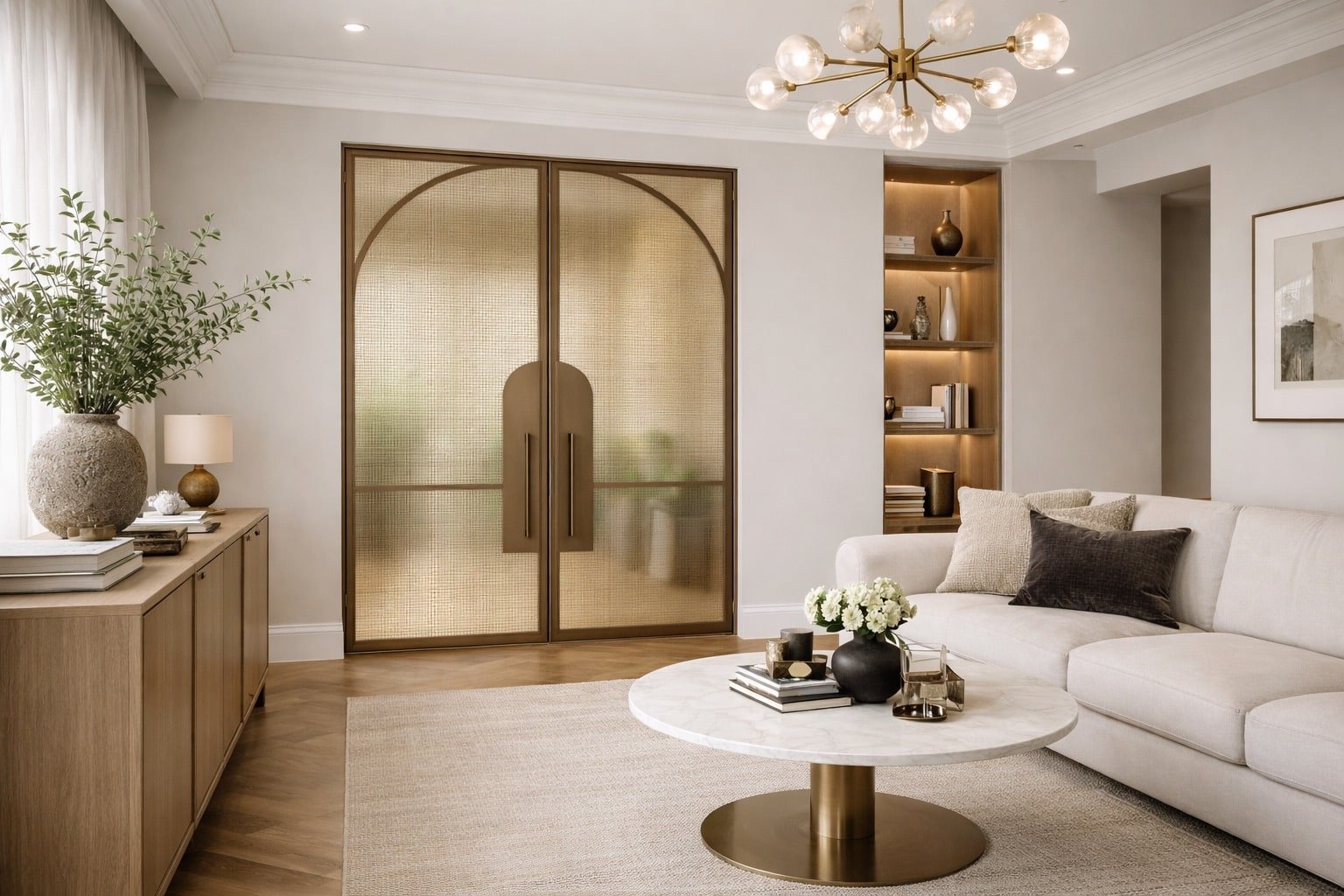
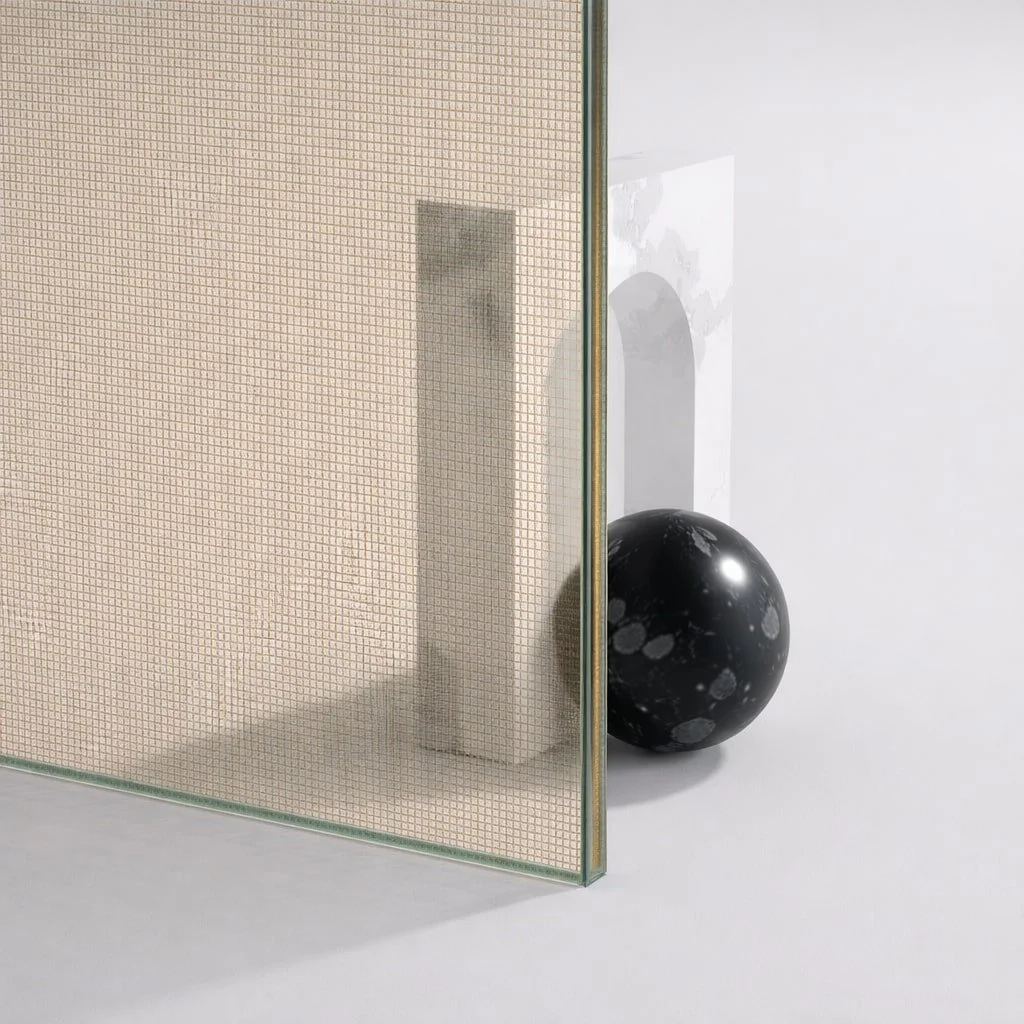
We are increasingly seeing the use of bespoke glazing being used, such a laminated glass, which includes mesh and fabric interlayers. These offer greater privacy and texture while allowing light to pass through.
Because laminated glass is typically thicker than standard 6mm toughened glass, early planning is essential. In some cases, door systems must be adapted to accommodate increased glass thickness, something only possible with bespoke fabrication.
Clear Glass
Maximises natural light flow between rooms
Maintains full visual connection across spaces
Ideal for open-plan layouts, hallways and living areas
Enhances the sense of space and openness
Works well where privacy is not a primary concern
Allows steel framework and bar layouts to be fully appreciated
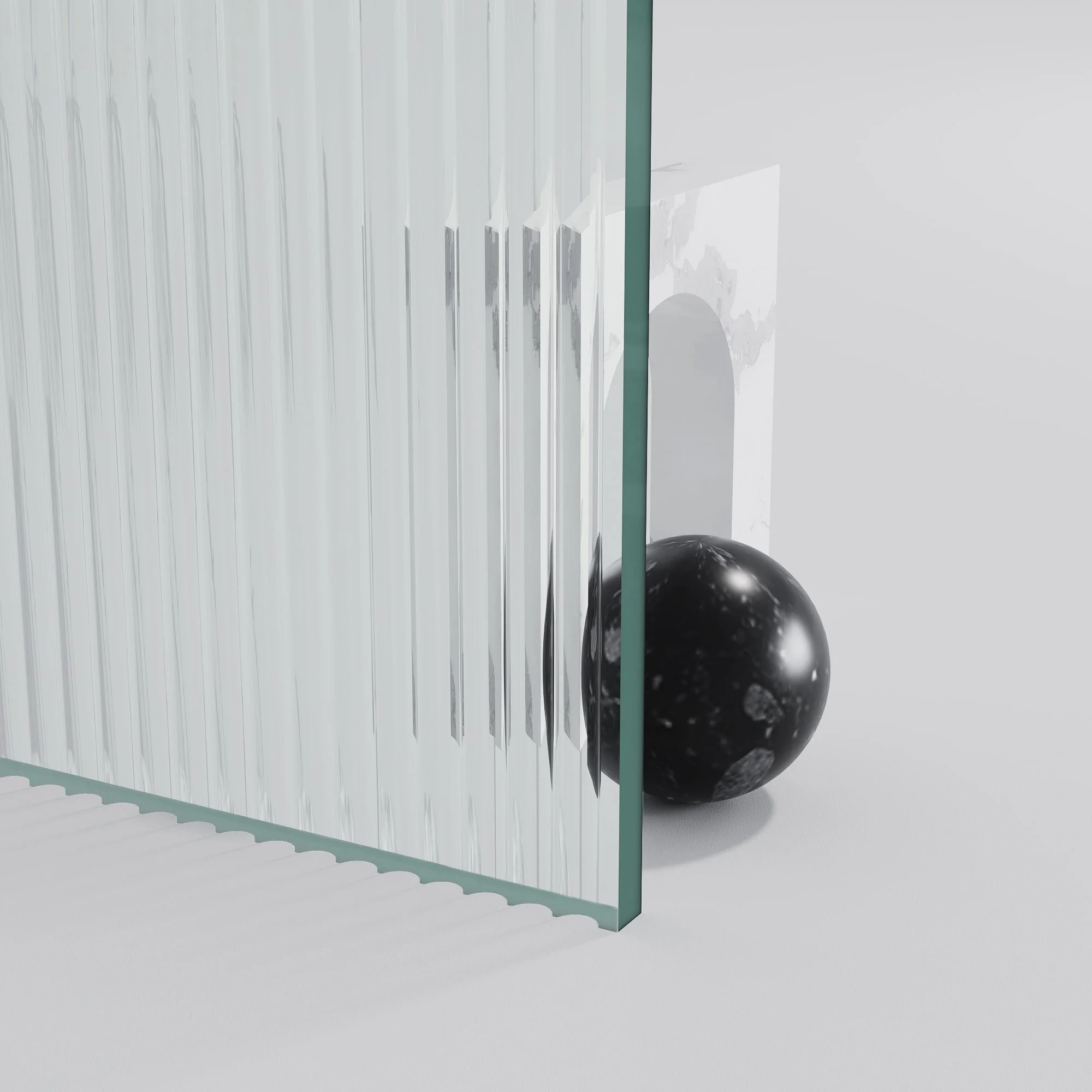
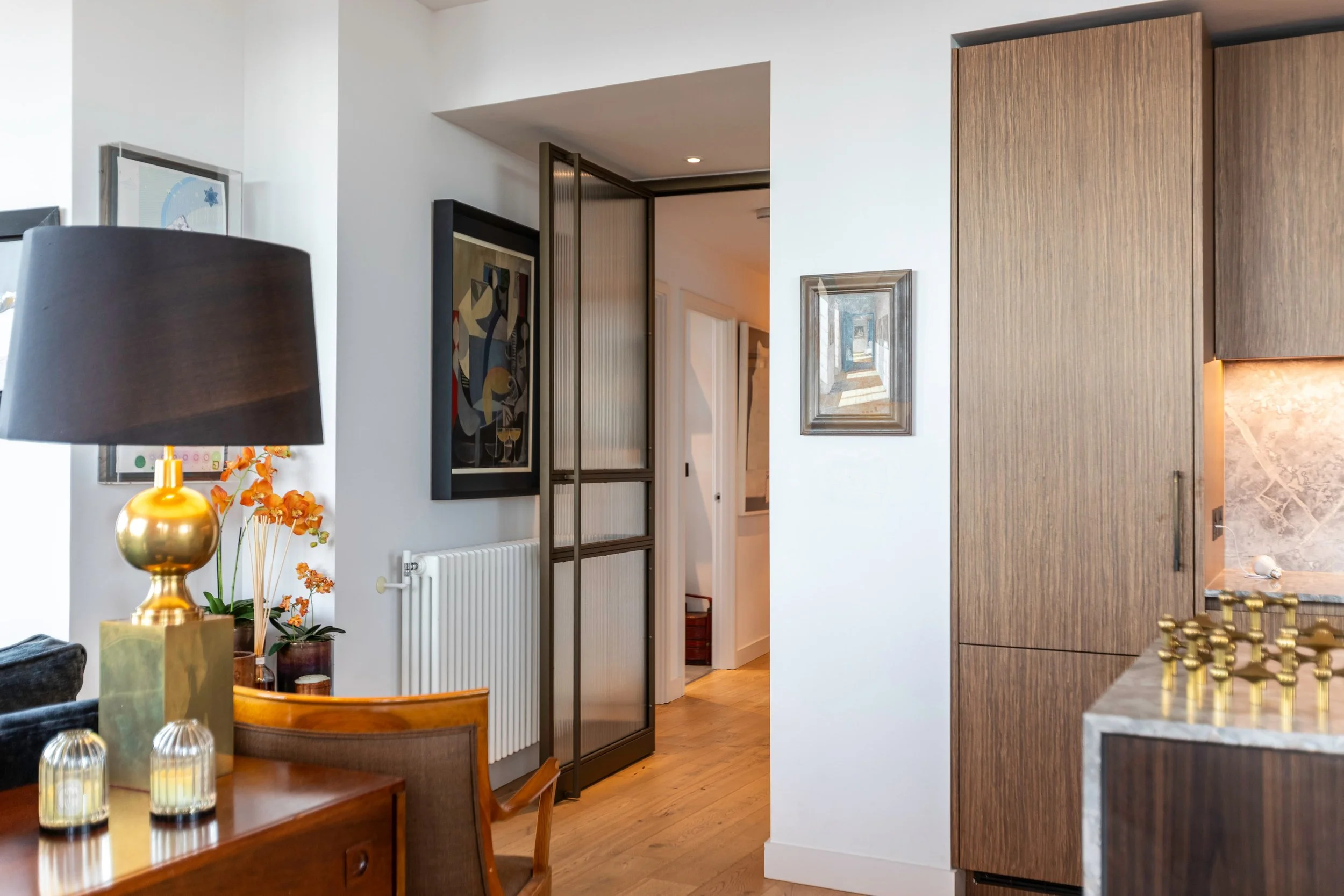
Reeded Glass
Softens visibility while still allowing light to pass through
Introduces texture and visual interest without heaviness
Ideal for spaces requiring subtle privacy such as home offices, snugs and dressing areas
Reduces glare and softens reflections
Adds depth and character, particularly in contemporary or transitional interiors
Pairs well with both minimal and more expressive bar layouts
Mesh Laminated Glass
Incorporates a metal or fabric mesh interlayer within laminated glass
Offers increased privacy while maintaining a light, architectural feel
Adds a bespoke, design-led aesthetic not achievable with standard glazing
Creates visual depth and subtle patterning within the glass
Ideal for statement doors, feature screens and design-focused interiors
Allows clients to achieve a highly customised look aligned with their interior palette

Natural Light: Why Steel Doors Perform So Well
Light becomes more valuable the deeper a floor plan goes. Steel internal doors are particularly effective at redistributing natural light through a home.
Their slim frames allow:
Larger glazed areas
Reduced visual interruption
Light transfer between rooms
Brighter hallways, basements and snugs
In winter months, when daylight is limited, this becomes especially important.
Steel doors outperform timber and many aluminium systems in this regard due to their structural strength and minimal sightlines.
Renovation vs New Build: A Different Approach
Steel doors play a different role depending on whether the project is a renovation or a new build.
In renovations:
Apertures may be fixed or restricted
Surveys are critical
Bespoke adaptation is often required
In new builds:
Openings can be designed around the doors
Proportions can be perfected from the outset
Fire strategy can be integrated early
In both cases, early planning leads to better outcomes, but in renovations, it is often the difference between success and compromise.
Bar Layouts, Sightlines & Interior Architecture
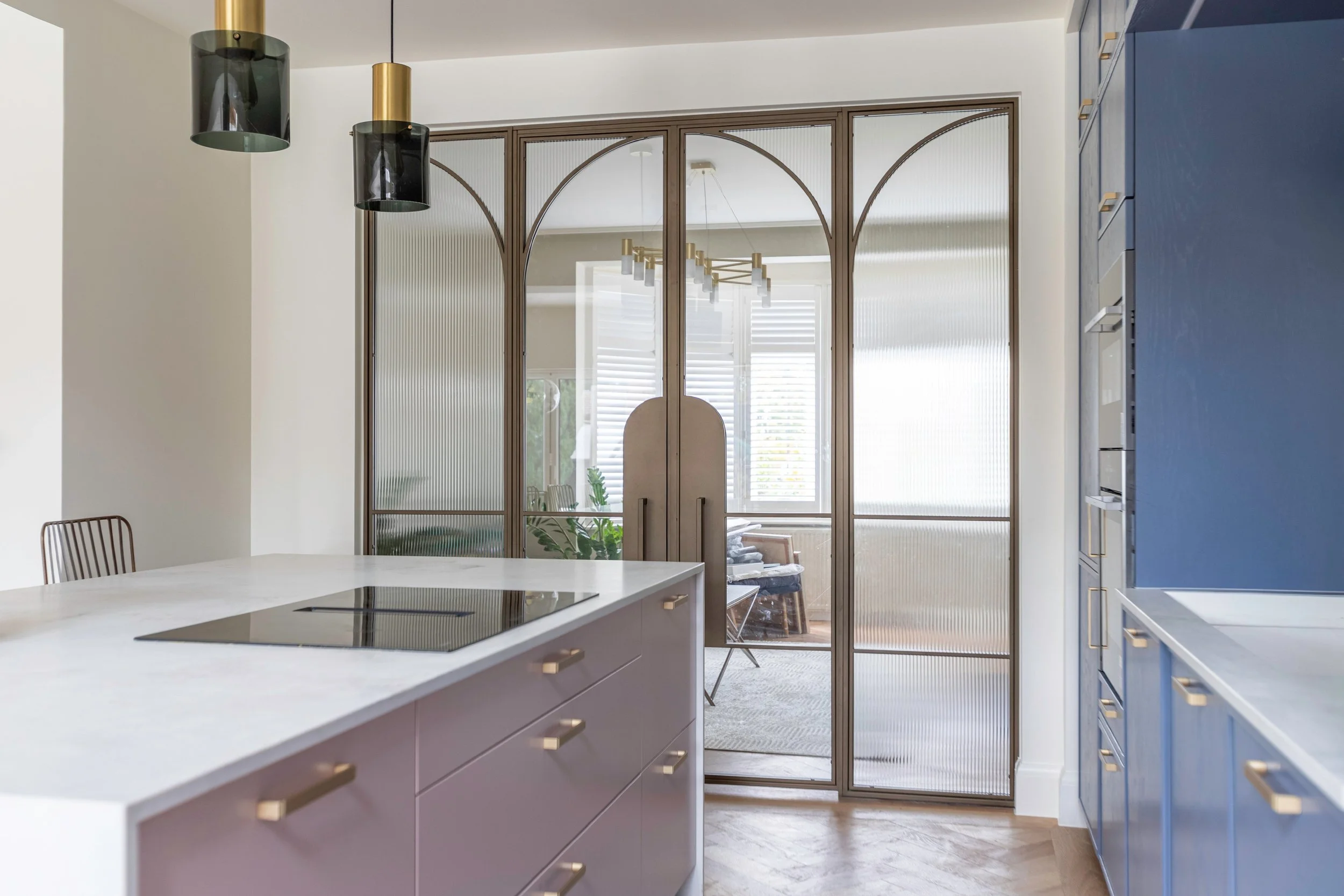
Bar layout is not decorative; it is architectural.
When planned early, bar layouts can:
Align with window mullions
Mirror joinery lines
Sit symmetrically within panelling
Reinforce rhythm across multiple rooms
Late-stage decisions often force generic layouts that miss these opportunities.
Get inspiration from our design page, where we have an array of classic, traditional, arched and lattice designs to get creativity from.
Finishes Work Best When Considered with the Wider Scheme
Steel door finishes should tie in with:
Kitchens
Staircases
Lighting
Electrical fittings
Furniture
Planning early allows samples to be reviewed alongside other materials, ensuring harmony rather than contrast.
In 2026, we expect continued growth in:
Warm metallics
Bronze and champagne tones
Antique-inspired finishes
Antique Mirrored Glass & Character Finishes
Antique mirrored glass is becoming increasingly popular, offering:
Depth and texture
Aged character
Soft reflectivity
With many variations available, clients can select the exact tone and ageing effect they want. Paired with bronze frames, antique mirror allows brand-new doors to feel like an integral part of the building’s history.
Handles, Hardware & Functionality
Handles affect:
Visual balance
Ergonomics
Fire compliance
Door operation
Because steel doors are bespoke, handle positioning and design can be tailored. It is worth keeping in mind that most fire-rated doors require lever handles, which must be integrated into the design early for consistency.
Installation, Lead Times & Project Sequencing
Steel doors sit between multiple trades:
Flooring
Plastering
Decoration
Joinery
Early planning allows:
Clean reveals
Flush finishes
Proper protection
Efficient installation
This avoids rushed decisions at the end of a build.
How Steel Doors Influence Day-to-Day Living
Beyond aesthetics, steel doors influence:
How spaces are used
How families interact
How homes adapt throughout the day
They allow spaces to open and close fluidly, supporting modern living without sacrificing connection.
FAQs: Planning Steel Internal Doors
When should steel doors be specified in a renovation?
Ideally, at the concept or layout stage.
Are steel doors suitable for period homes?
Yes, especially when proportions and detailing are considered early.
Do fire-rated steel doors look bulky?
Not all of them; it depends on the chosen solution.
Can steel doors increase natural light?
Yes, significantly.
Conclusion: Start with the Doors, Not the Compromises
If steel internal doors are part of your 2026 renovation plans, they should be considered from the very beginning of the project, not as a finishing touch, but as a defining architectural element. When planned early, steel doors do far more than divide spaces. They help establish proportion, guide movement through the home, frame views and shape how light travels from room to room.
Early consideration allows steel doors to be integrated seamlessly into the wider design strategy, aligning with ceiling heights, structural openings, glazing choices and fire safety requirements. It avoids the compromises that often arise when doors are introduced late, such as reduced heights, forced layouts or unnecessary visual bulk. Instead, doors become intentional, cohesive and quietly powerful components of the interior.
As homes continue to evolve toward more open, flexible and design-led living, steel internal doors offer a solution that balances openness with definition and character with practicality. Whether the goal is to enhance natural light, introduce subtle privacy, meet regulatory requirements or create a striking architectural feature, the success of the outcome is almost always determined by timing.
Planning steel doors early is not simply a technical decision; it is a design one. Done well, it elevates the entire renovation and ensures that every space feels considered, connected and built to last.
Looking for steel doors in 2026?
Enquire today to discuss your next project:
Submit an enquiry or call our team for a tailored consultation.
Let’s Talk
Whether you're renovating a home, specifying for a new build, or delivering a luxury interior for a client — we’re here to help.
At Joshua James, we work with architects, interior designers, homeowners and contractors across the UK to design and supply bespoke steel internal doors. Every door is crafted to exacting standards, tailored to suit each project’s vision, and built to stand the test of time.
If you're ready to elevate your next project with precision-made steel framed doors, let’s talk.