How to Choose the Right Finish for Your Steel Internal Doors
When homeowners begin planning their steel internal doors, much of the early conversation centres on design — bar layouts, glass type, configuration. The finish often comes later, treated almost as an afterthought. In reality, it is one of the most consequential decisions you will make. The finish determines how your doors read within a room, how they age, how they interact with your lighting, and whether they feel like a considered part of your interior or something that simply arrived.
This guide is written for homeowners at the point of choosing. Whether you are at the early stages of a renovation or finalising the details of a new build, it covers everything you need to know to make the right call.
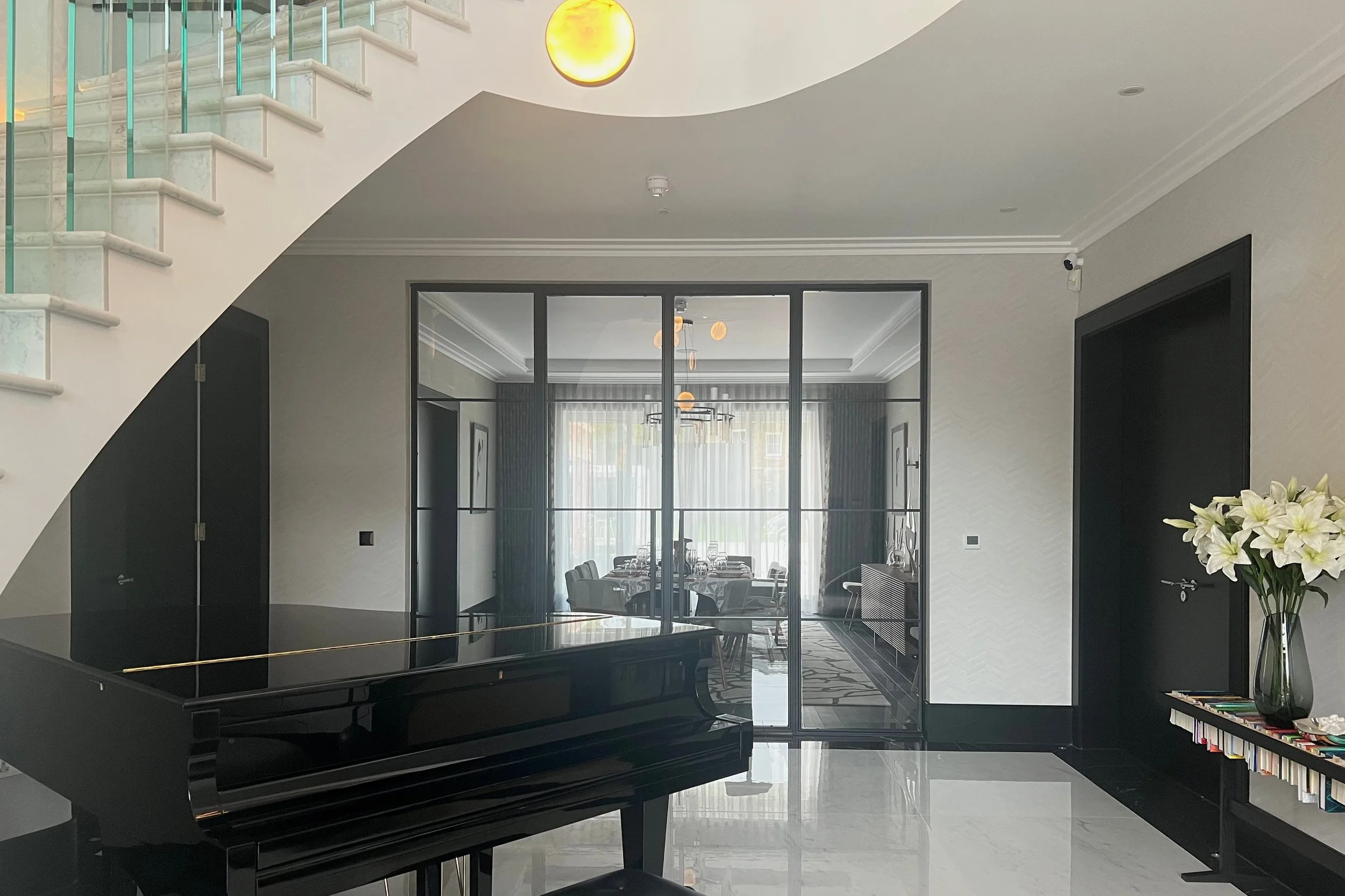
Why the Finish Matters More Than You Might Think
Steel internal doors are long-term investments. At Joshua James, the average project lifetime is measured in decades, not years. The finish you choose today will still be the finish you live with in fifteen years — which means it deserves the same level of thought as any other design decision in your home.
Beyond longevity, finish has a significant effect on perception. A black door in a narrow hallway creates a very different atmosphere to the same door in a soft anthracite. A bronze-toned finish in a kitchen extension will catch the evening light differently to a cool graphite. These are not minor variations. They are the difference between a door that elevates a room and one that merely occupies it.
The finish also interacts with every other material in a space — the floor, the joinery, the metalwork on your kitchen handles and light fittings. Getting this right is a matter of looking at the whole room, not just the door.
A full range of our finishes are available on Finishes page.
Powder Coat: The Foundation of Steel Door Finishing
The majority of steel internal doors — ours included — are finished in polyester powder coat. This is the industry standard for good reason: it is durable, consistent, and available in an enormous range of colours. Understanding how it works helps you make better decisions when specifying your finish.
Powder coat is applied electrostatically and then cured under heat, creating a hard, smooth surface that bonds directly to the steel. When applied correctly, it resists chipping, scratching and fading far better than conventional paint. It also provides a uniform, professional result that is difficult to achieve any other way.
At Joshua James, our powder coat finishes are available in any RAL colour — which means you are not limited to a shortlist of options. You are selecting from a palette of thousands.
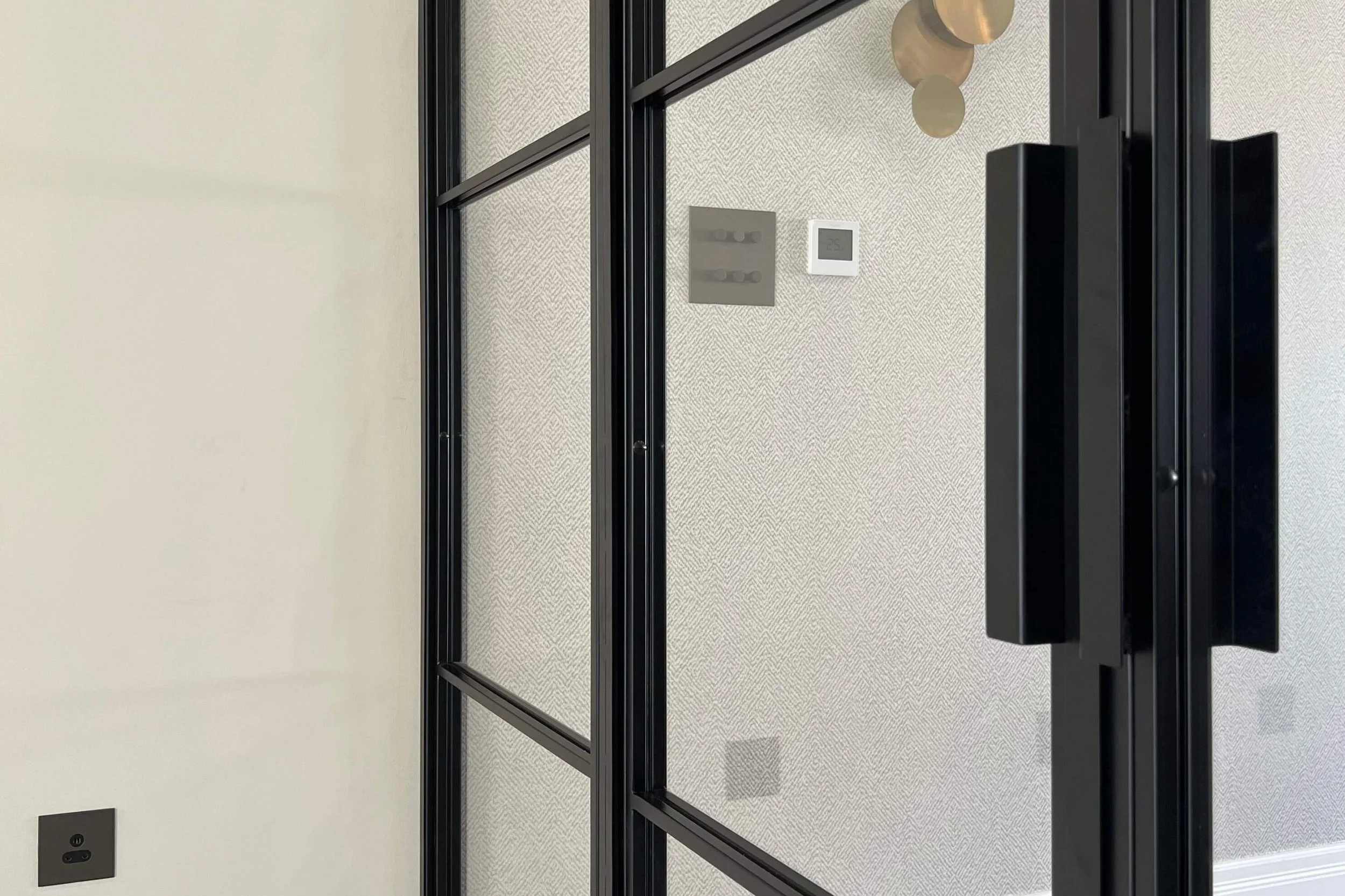
RAL Colours: Understanding Your Options
RAL is the European standard colour matching system used across architecture, manufacturing and product design. For steel doors, it is the reference point for specifying any powder coat colour with precision. Rather than describing a colour as "dark grey" or "off-white" and hoping for the best, a RAL number tells the manufacturer exactly what shade to apply.
The most commonly specified RAL colours for steel internal doors are:
RAL 9005 — Jet Black. The classic choice. Deep, flat, and unambiguous. It creates strong contrast against light walls and pale flooring, and it pairs naturally with the industrial heritage of steel framing. If you are drawn to steel doors because you have seen them on Instagram or in interior design publications, the chances are you are looking at RAL 9005.
RAL 7021 — Black Grey. Darker than anthracite but warmer than jet black, RAL 7021 sits in a unique position on the spectrum that makes it one of the most liveable dark finishes available. Where RAL 9005 can feel stark in certain lights and RAL 7016 reads unmistakably as grey, 7021 occupies the space between — deep enough to feel bold, but with enough warmth to avoid severity. It works particularly well in rooms with lower ceilings or less natural light, where a true black might feel oppressive but a mid-grey would lose its presence. It is also an excellent choice when paired with warm-toned ironmongery — aged brass, unlacquered bronze, or brushed gold — as the slight warmth in the finish creates a natural affinity rather than a forced contrast.
RAL 7016 — Anthracite Grey. One of the most popular choices in contemporary residential design. Anthracite reads as dark but is unmistakably grey rather than black, which makes it more versatile in rooms with mixed tones. It works particularly well alongside brushed brass or aged bronze ironmongery.
RAL 9003 — Signal White. The definitive white in the RAL system, 9003 is a clean, bright white without the warmth of cream or the coolness of blue-white. For steel doors, it is an increasingly confident choice — particularly in period homes where black might feel too industrial, or in contemporary interiors where the goal is to keep the architecture light and the visual weight low. White steel doors in 9003 read as crisp and precise, which suits the material well. They work especially effectively in rooms with strong natural light, where the frame becomes a graphic element rather than a dominant one — all structure, no heaviness. Paired with brushed nickel or polished chrome ironmongery, the result is clean and considered. Paired with brass, it takes on more warmth and personality.
Custom RAL colours. If none of the above is quite right, the answer is simply to specify another RAL number. We work with homeowners and their designers to match finishes to existing ironmongery, joinery, or specific material palettes. Bring a sample, share a reference, or specify the exact RAL — we can work with all three.
Smooth or Textured Powder Coat?
RAL colour is only half of the equation. The texture of the powder coat — whether the surface is smooth or carries a fine grain — is equally important and often overlooked until it is too late.
Smooth powder coat produces a flat, even surface that is precise and clean, suiting the sharp lines of steel framing naturally. In good light it has a quiet confidence — it does not draw attention to itself, it simply does its job. It works across a wide range of interior styles from industrial to contemporary to classic, and is the finish that most people picture when they imagine a steel door done well.
Textured powder coat introduces a fine grain to the surface — similar in character to a very subtle tactile effect — that changes how the door reads in different lighting conditions. In raking or directional light, the texture becomes slightly visible, adding depth and materiality. In diffuse light, it reads as quieter and more restrained. The practical benefit is that textured powder coat is more forgiving in high-traffic areas — minor scuffs and fingermarks are far less visible than on a smoother surface, which makes it a considered choice for doors in hallways, family homes, or anywhere that sees heavy daily use.
Both have their place and the right choice depends entirely on context. For a statement door in a formal living space or a principal bedroom, a smooth finish tends to complement the precision of the design. For doors that need to work hard and look good over years of daily use, a textured finish is worth serious consideration.
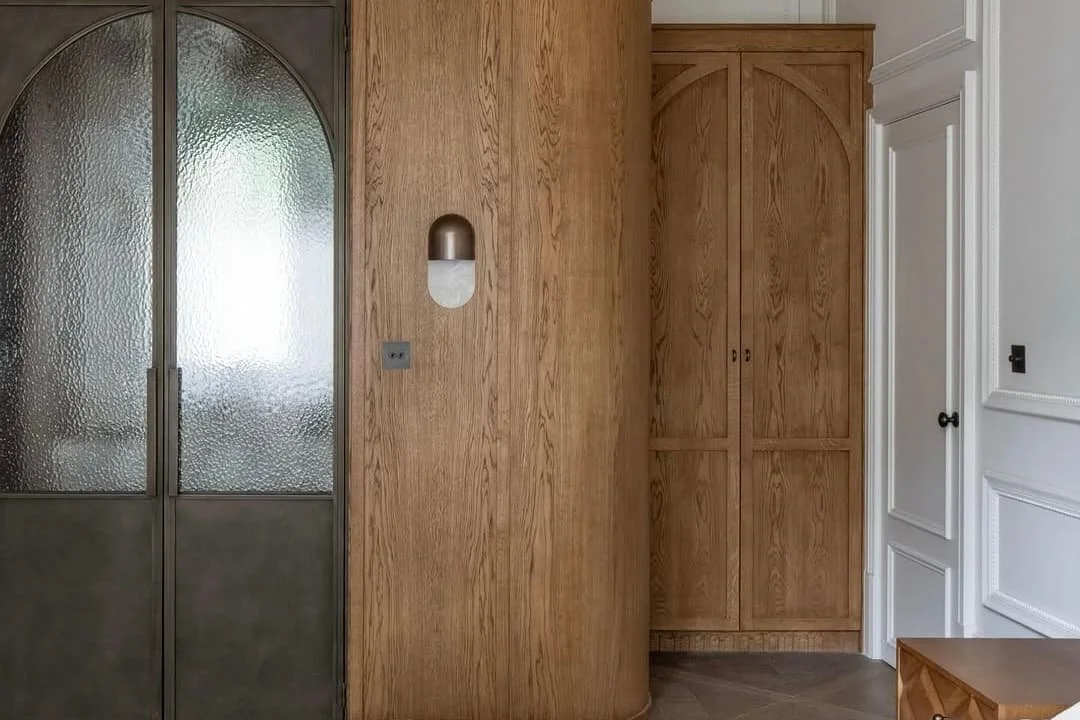
Premium Metal Finishes: Beyond Powder Coat
For projects where standard powder coat is not sufficient, Joshua James offers a range of premium metal finishes. These are specified when homeowners want something that reads as genuinely material — a surface with depth, warmth and character that a standard powder coat cannot replicate.
Bronze. A warm, golden-brown finish with a depth that changes depending on the light. Bronze-finished steel doors are particularly effective in kitchen extensions and open-plan living spaces where the warm tones complement timber, stone and natural materials. Paired with matching bronze ironmongery from our Hardware & Furniture collection, the effect is cohesive and considered.
Aged or Patinated Effects. For homes with a heritage character — period conversions, Georgian townhouses, Arts and Crafts properties — a patinated or aged finish can bridge the gap between the original architecture and a contemporary steel door. These finishes suggest history without compromising the precision of the product.
Premium metal finishes are applied to order and require slightly longer lead times than standard powder coat. They are worth discussing early in the project, ideally during your initial design consultation.
How Finish Interacts with Glass Choice
Finish does not exist in isolation. The glass you choose — clear, reeded, frosted, or any of our other options — will significantly affect how the finish reads in a room.
Clear glass maximises the visual impact of the frame. The finish is always visible, always doing its job. This works best when the finish is confident — a strong black or a striking bronze — and the door is intended to be a feature.
Reeded glass softens and diffuses the view through the door, which slightly reduces the visual prominence of the frame. In this context, a more subtle finish — anthracite rather than jet black, or satin rather than gloss — can feel more balanced.
Frosted glass, by reducing transparency almost entirely, shifts the focus almost entirely to the frame itself. The finish becomes the primary visual element, which makes the quality of that finish especially important.
Our Glass Types page covers the full range of options and how they interact with different environments.
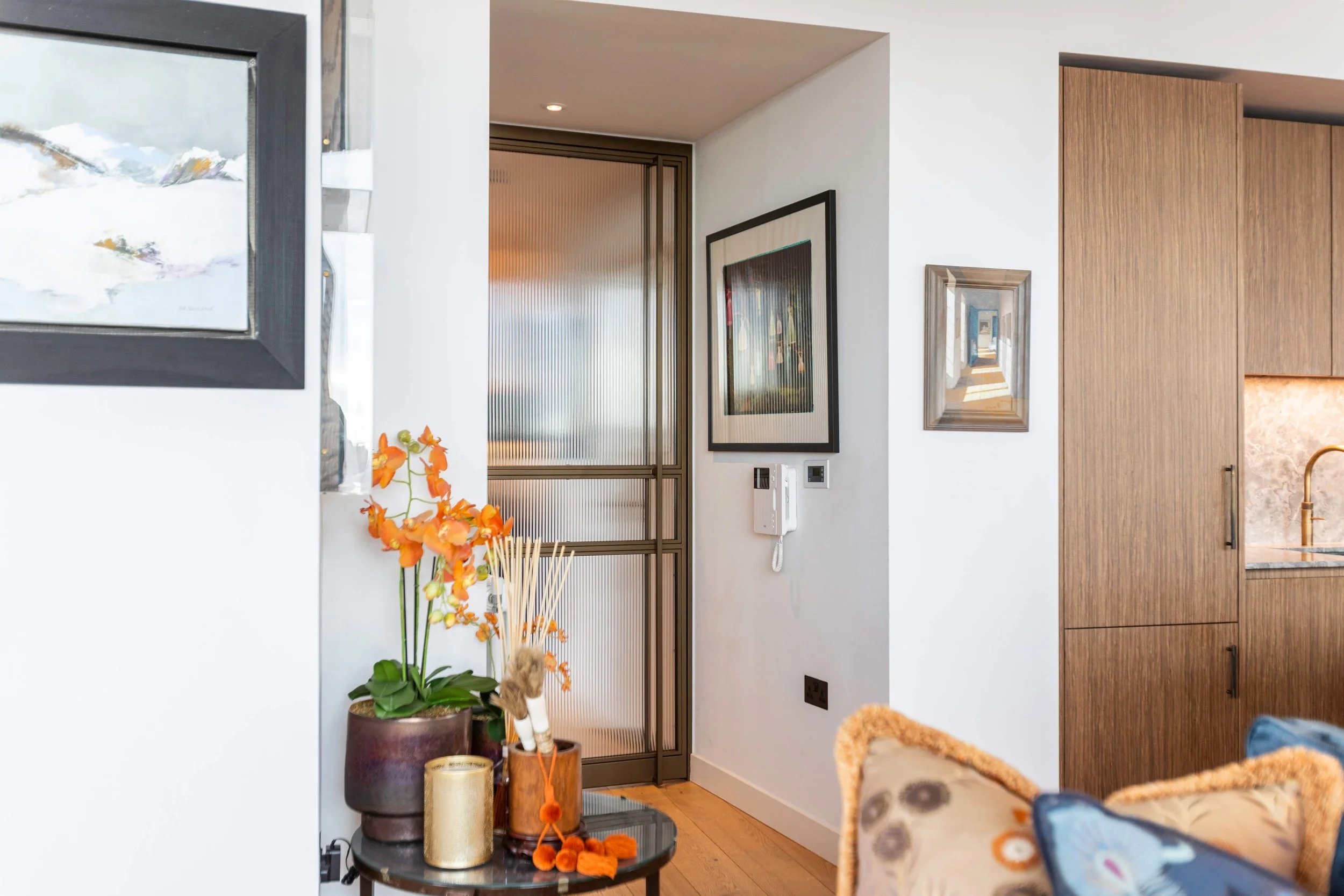
How Finish Interacts with Ironmongery
The handles, and other accessories you choose should complement your finish, not fight against it. This is an area where it is worth spending time, because an ill-matched handle can undermine an otherwise excellent door.
At Joshua James, our Hardware & Furniture collection is designed to work in combination with our door finishes. A matt black door paired with a matt black linear handle creates a clean, monolithic result. The same door with a brushed brass handle introduces warmth and contrast. An anthracite door with an aged bronze handle sits somewhere between the two — confident, warm, and slightly softer than a full black scheme.
The principle is straightforward: decide whether you want your ironmongery to blend or contrast, then choose accordingly. Both are valid. Blending creates unity. Contrasting creates detail.
Matching Your Finish to Your Interior
The most common mistake homeowners make at this stage is choosing a finish in isolation — looking at a sample card without considering how it will sit within the actual room. Here are the questions worth asking before you commit:
What are the dominant materials in the space? Warm materials — timber, terracotta, aged brass, stone with red or orange tones — tend to work better with warmer finishes: bronze, graphite black, or an anthracite with warm undertones. Cool materials — white marble, brushed nickel, concrete, pale grey stone — suit cooler finishes: jet black, slate grey, or white.
How much natural light does the room receive? In a bright, south-facing room, a strong black door will read clearly all day. In a north-facing room with limited light, the same door might absorb too much and make the space feel heavier. In lower-light settings, an anthracite or a dark grey can give you the strength you want without the weight.
What other metalwork is in the space? Your door finish will read alongside light fittings, kitchen handles, radiators and architectural ironmongery. It does not need to match exactly — mixing metals is a legitimate and often sophisticated approach — but there should be a relationship between them. A bronze door in a room full of chrome fixtures will likely feel disconnected.
Are your doors a feature or a backdrop? If you want the doors to be noticed — to be a talking point, to define the architecture of the room — choose a finish that commands attention. If you want them to sit quietly and do their job, choose something that harmonises rather than contrasts.
Visiting the Showroom
For all the guidance a written resource can offer, there is no substitute for seeing finished doors in person. Our showroom in Surrey allows you to view a range of our products across multiple configurations, finishes and glass types in the same space. You can see how a matt black door reads against different wall colours, how a bronze finish behaves in changing light, and how the ironmongery feels in your hand.
Most homeowners who visit leave with greater clarity and confidence than any amount of online research could provide. If you are working through a significant project, it is worth making the trip.
The Joshua James Approach to Finish Specification
At Joshua James, finish is never an afterthought. It is part of the design conversation from the beginning, discussed alongside bar layout, glass type, configuration and ironmongery. Our team will guide you through the options, ask the right questions about your interior, and where needed, produce sample reference cards for you to take home and compare in your own light.
Every door we produce is made to order — which means there is no compromise between what you want and what we can deliver. If you have a specific RAL in mind, a material reference, or a finish you have seen elsewhere and want to replicate, bring it to us and we will work from there.
To begin the conversation, visit our Interior Collection or get in touch directly.
Let’s Talk
Whether you're renovating a home, specifying for a new build, or delivering a luxury interior for a client — we’re here to help.
At Joshua James, we work with architects, interior designers, homeowners and contractors across the UK to design and supply bespoke steel internal doors. Every door is crafted to exacting standards, tailored to suit each project’s vision, and built to stand the test of time.
If you're ready to elevate your next project with precision-made steel framed doors, let’s talk.